Software

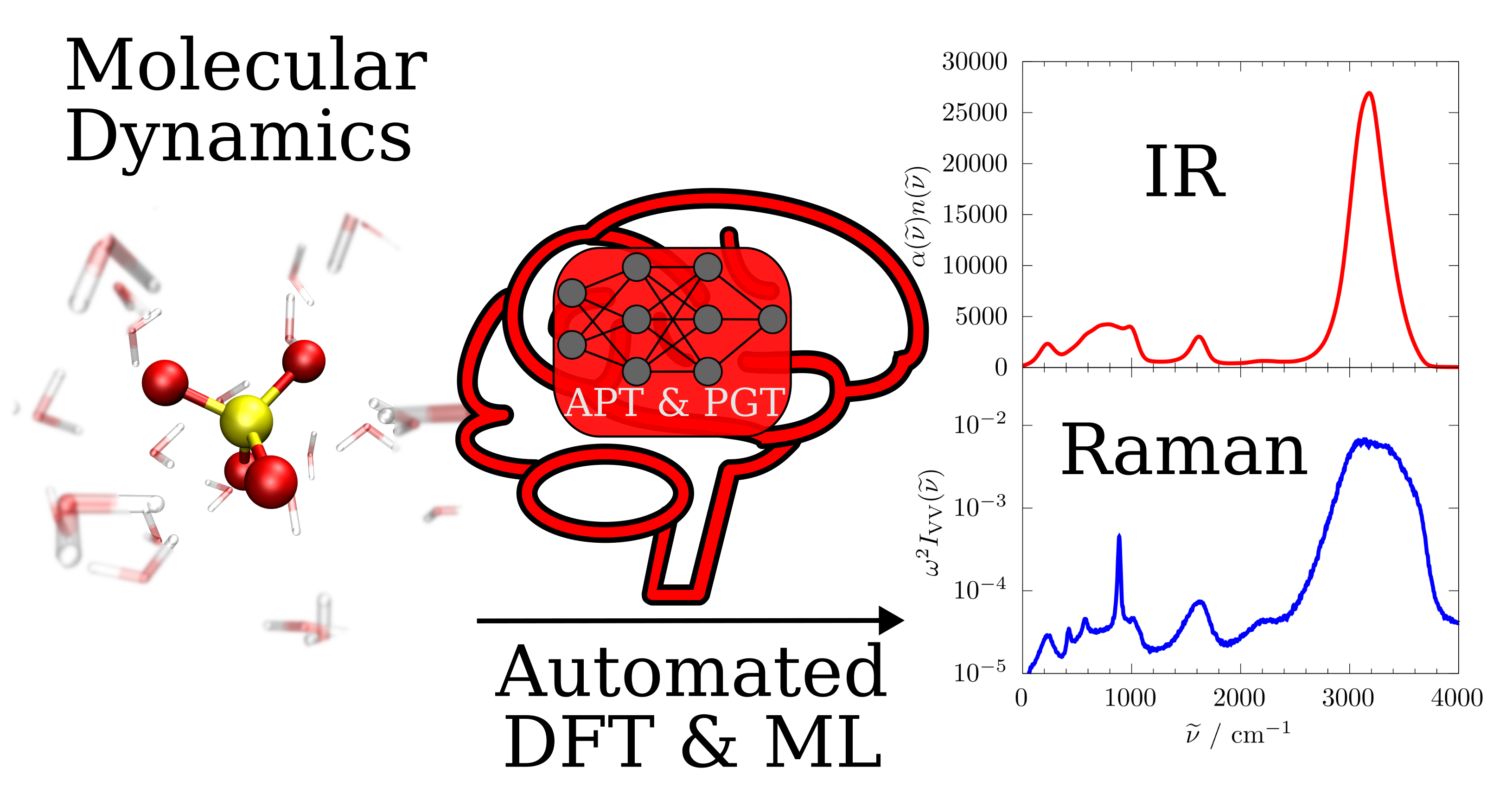
Mimyria [J. Chem. Theory Comput., 2026], is a modular framework for predictive vibrational spectroscopy from molecular dynamics simulations. It combines electronic-structure calculations, machine-learning response models, and automated spectral analysis within a unified workflow for infrared (IR) and Raman spectroscopy in condensed phases.
The framework enables the efficient calculation of fully anharmonic, temperature-dependent vibrational spectra from large-scale molecular dynamics simulations while retaining electronic-structure accuracy. To this end, mimyria implements machine-learning models for atom-resolved spectroscopic response properties, including atomic polar tensors (APTs) for IR spectroscopy and polarizability gradient tensors (PGTs) for Raman spectroscopy.
Starting from an existing machine-learning potential and molecular dynamics trajectory, mimyria provides the complete pipeline required to generate predictive vibrational spectra. The software automates electronic-structure reference calculations, response-tensor generation, machine-learning training, validation, and the final computation of IR and Raman spectra from MLMD simulations. By validating models directly at the spectral level and connecting machine-learning errors to observable spectral accuracy, mimyria enables data-efficient and quantitatively reliable spectroscopy simulations for complex molecular systems.
The repository contains training workflows, spectral-analysis tools, and example applications for IR and Raman spectroscopy from machine-learning molecular dynamics simulations. Feel free to explore!
GithubAtomic Polar Tensor Neural Network
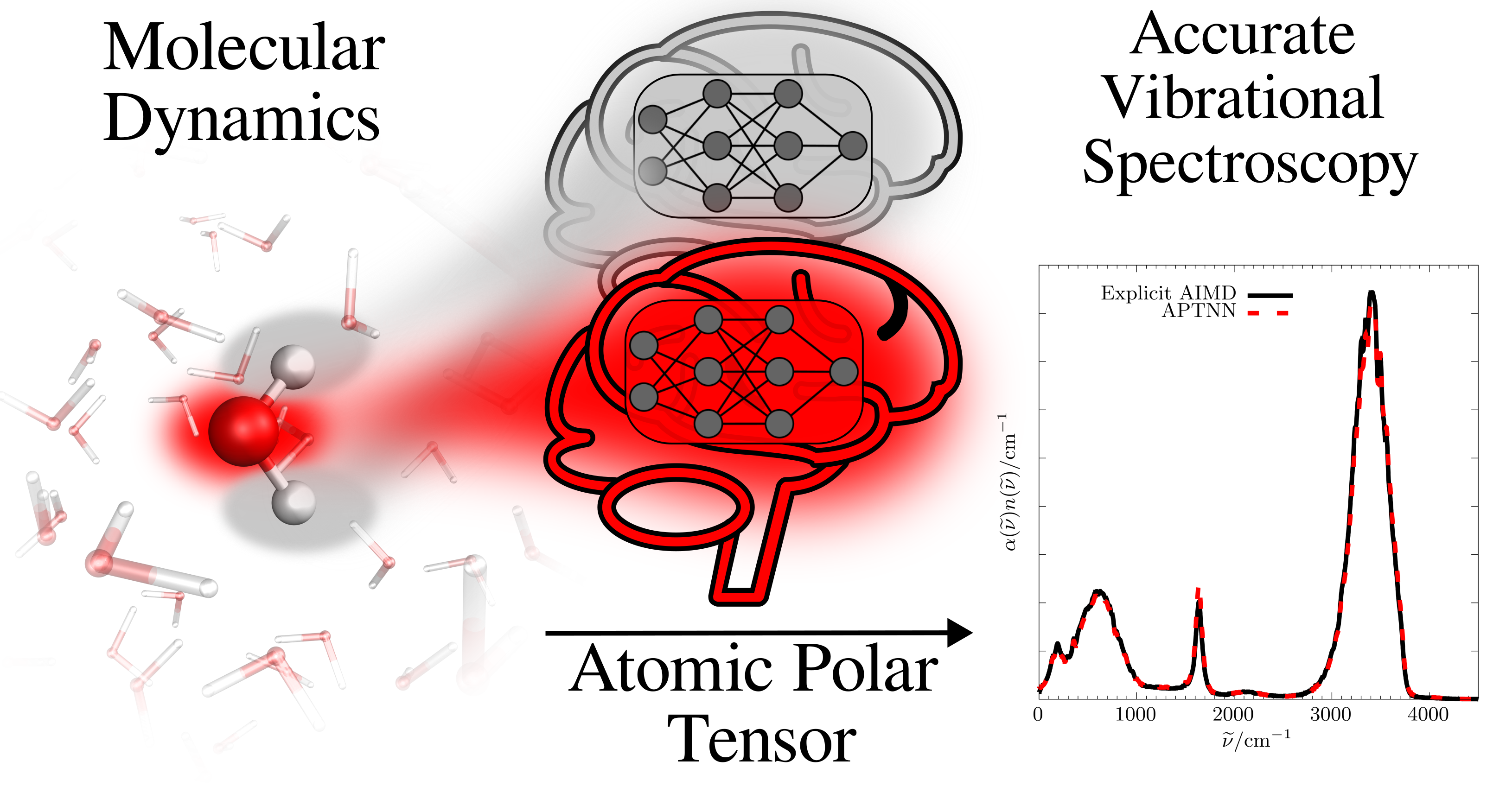
P. Schienbein. J. Chem. Theory Comput 2023, 19, 705
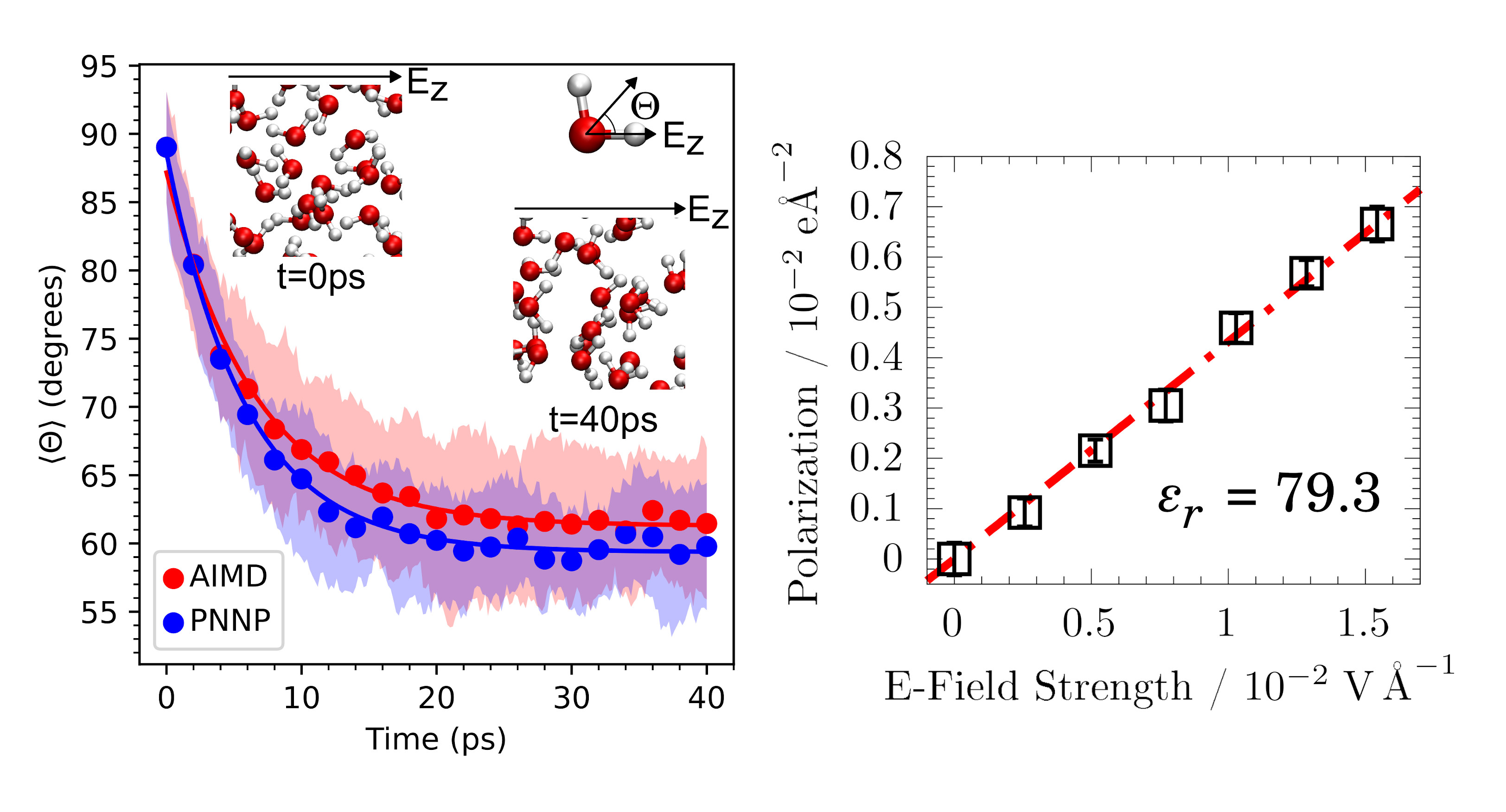
The Atomic Polar Tensor Neural Network (APTNN) has been introduced to compute IR spectra from molecular dynamics simulations leveraging machine learning [J. Chem. Theory Comput., 2023]. It has also been used include electric fields in machine learning molecular dynamics simulations in a perturbative approach [Nat. Commun., 2024].
The APTNN is now considered legacy software, as its functionality has largely been integrated and extended within the Mimyria framework, which provides a more general and automated workflow for predictive vibrational spectroscopy.
The repository nevertheless remains available and contains scripts and examples for training APTNN models and conducting electric-field simulations. Feel free to explore!
Github